- Copywork365
- Posts
- 17-OCT-2025 | The Oxford English Dictionary’s “Krazy” Ad
17-OCT-2025 | The Oxford English Dictionary’s “Krazy” Ad

Dan Bogachek
October 17, 2025


Toolbox by Copywork365

Liking the daily exercise?
Wait till you see this.

Toolbox is your swipe file on roids.
It’s a database of world-class excerpts just like the ones we cover right here on the daily.
Browse through hundreds of pieces (and growing!) spanning ad copy, webpage copy, and literature.
Each and every one comes with granular analysis on what makes everything tick and why it works.
All the tools, techniques, and psychology we touch on here, but in their full depth. Making it even easier to master these “devices” and apply them to your persuasive writing. And filtering by author or brand means you can steal the secret sauce from your very favorite writers, copywriters, and brands.
So if you’re looking to level up with a forever resource, I’ve got a forever deal for you.
Join the waitlist to get lifetime access for a single flat fee — when Toolbox launches.
Oh and I really do mean lifetime.
Even if the internet ceases to exist. I’ll work day and night to ensure you receive a physical book copy. Hell, clay tablets, if it gets that bad 😅.
Even when it’s 100’s of thousands of excerpts. Pinky promise.

The Oxford English Dictionary’s “Krazy” Ad
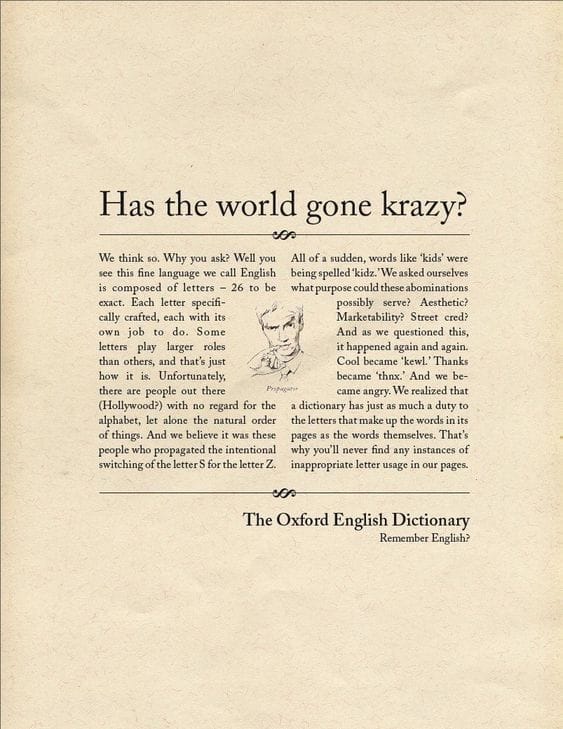
Has the world gone krazy?
We think so. Why you ask? Well you see this fine language we call English is composed of letters — 26 to be exact. Each letter specifically crafted, each with its own job to do. Some letters play larger roles than others, and that’s just how it is. Unfortunately, there are people out there (Hollywood?) with no regard for the alphabet, let alone the natural order of things. And we believe it was these people who propagated the intentional switching of the letter S for the letter Z. All of a sudden, words like ‘kids’ were being spelled ‘kidz.’ We asked ourselves what purpose could these abominations possibly serve? Aesthetic? Marketability? Street cred? And as we questioned this, it happened again and again. Cool became ‘kewl.’ Thanks became ‘thnx.’ And we became angry. We realized that a dictionary has just as much a duty to the letters that make up the words in its pages as the words themselves. That’s why you’ll never find any instance of inappropriate letter usage in our pages.
The Oxford English Dictionary
Remember English?
🏁

This whole piece revolves around their big why. And their big why points to what? Credibility and trustworthiness. Detecting a why is simple. Whenever you see a brand say “we,” there’s a good chance “why” is also nearby.
Another reminder that we do actually have permission to ask questions in our copy — and not just in the hook.
Repetition for setup. “Cool became ‘kewl.’ Thanks became ‘thx.’ And we became angry.” Even the structure is emoting, “enough is enough.”
Even an institution as sophisticated as The Oxford English Dictionary is writing at a 5th grade level (a la Hemingway App). And they even use a fragment sentence…
